A Place of Refuge
This was presented as a sermon to Lethbridge First Baptist Church on October 11, 2026. The live recording may be found here.
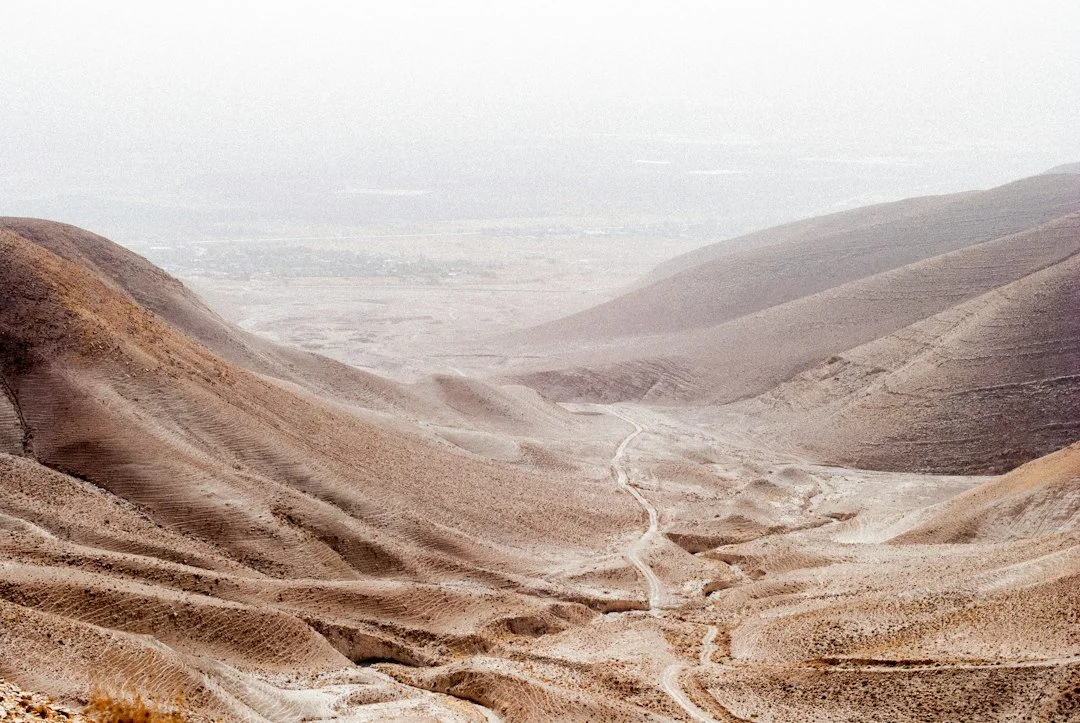
Photo by Eddie & Carolina Stigson on Unsplash
Today’s story is a direct continuation from last week’s passage. David’s reliance on God to provide for him is contrasted again to Saul’s tendency to rely on himself. David is on the run from Saul, alone and destitute. The Philistine king recognizes him as the commander of Saul’s armies, which only increases the danger to David while he is in their territory. Instead of presenting himself to the king of Gath as a valuable hostage, David pretends to be insane, causing the king to cast him out in disgust.
And so, David flees to the caves of Adullam, which were located somewhere in the hill country of Israel. When David’s brothers and parents hear about David’s new hiding place, they join him there. As the family of the kingdom’s number one most wanted, they are in danger of being arrested, too. Remember—Saul tried to kill his own son Jonathan when he suspected Jonathan of protecting David back in chapter 20, so I wouldn’t put it past Saul to kill David’s family just to root David out. Clearly, David’s family thought so too, because they join David in hiding.
But it’s not only David’s family that joins him in the caves. A variety of other men join him there—those who were “in distress or in debt or discontent.” We don’t know why they are distressed, but they are drawn to David for one reason or another. They are unhappy with Saul’s increasingly oppressive reign and are looking for another king to follow. David doesn’t declare his kingship—not yet—but he allows the men to join him. At a time when these men felt unsafe to continue their everyday lives, David provides a place of refuge. It’s ironic that the caves of the hill country provide more safety than the cities of Israel under Saul’s rule. It’s telling; Saul’s reign is not a safe place for his own people.
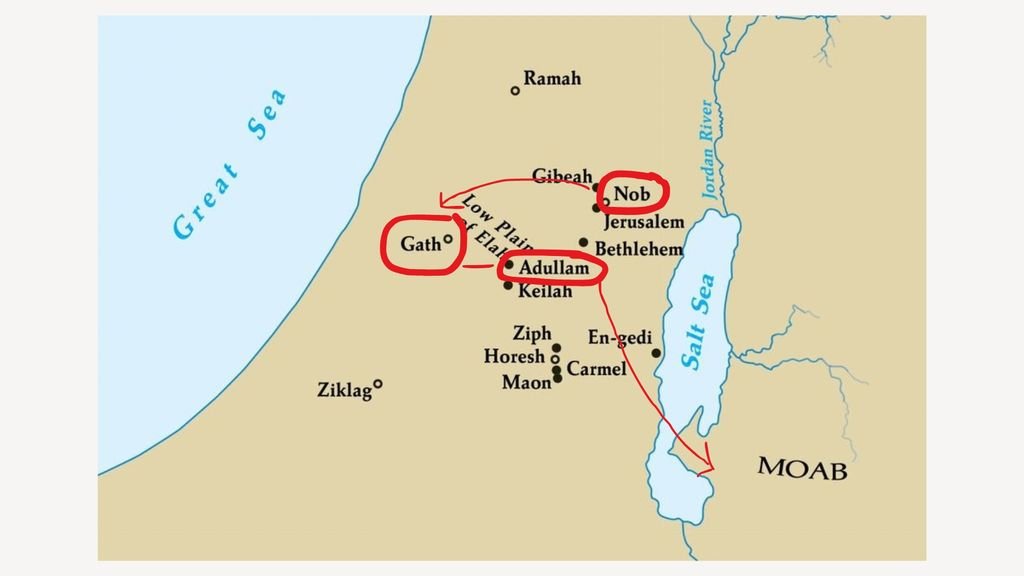
Map of Ancient Israel during Saul’s reign, source unknown.
You may recall Samuel’s warning to Israel when they asked for a king—the king would take their sons to be soldiers and blacksmiths for his army, their daughters to cook for him, serve him, and entertain him, and the finest of their fields, crops, and animals for his own. First Samuel 8 says, “‘You will be his slaves. When that day comes, you will beg for relief from this king you are demanding, but the Lord will not help you.’ But the people refused to listen to Samuel’s warning. ‘Even so, we still want a king,’ they said. ‘We want to be like the nations around us. Our king will judge us and lead us into battle.’”[1]
Saul is an increasingly paranoid tyrant—this is who Israel asked for as their king instead of trusting God to lead them. Now, remember that Saul had several opportunities to follow God’s ways, but each time he chose instead to protect himself, build up his reputation by his own strength, and trust his own judgment more than God’s goodness. He was impatient and fearful, allowing his fear to make his decisions—never a good choice. As a result, God said he would take his kingdom from Saul and give it to someone else. And as Hannah told us last week, we’ve been seeing the contrast between David and Saul ever since.
So now, we have four hundred men who are fleeing oppression from King Saul and David allows them to join him in a loosely organized private army. I wonder if perhaps David felt like he could offer them refuge because he’d experienced God’s refuge himself many times. David wrote many psalms while he was on the run from Saul, including Ps 142, which says:
“I cry out to the LORD; I plead for the LORD’s mercy. I pour out my complaints before him and tell him all my troubles. When I am overwhelmed, you alone know the way I should turn. Wherever I go, my enemies have set traps for me. I look for someone to come and help me, but no one gives me a passing thought! No one will help me; no one cares a bit what happens to me. Then I pray to you, O LORD. I say, “You are my place of refuge. You are all I really want in life. Hear my cry, for I am very low. Rescue me from my persecutors, for they are too strong for me. Bring me out of prison so I can thank you. The godly will crowd around me, for you are good to me.””[2]
David is overwhelmed. His new followers are overwhelmed, too. But his very first thought in the midst of overwhelm is to find safety in God’s mercy and protection, which he then extends to those who have come to him. He does not run or hide from them; he doesn’t say, “Sorry guys, I’m in a precarious position here what with Saul trying to kill me and all, so I’m not sure you should join me.” They come to him, and he becomes their commander. I don’t think it is coincidence that they do so. David’s faith and trust in God are a spiritual place of refuge for them, just as much as the caves are a physical refuge from Saul. Hold onto that thought. We’ll come back to it.
The next thing David does is to go to Moab to provide protection for his parents. David’s great-grandmother, Ruth, was Moabite, so he could claim the protection of kinship. Tragically, we see that the land of the non-Israelites is safer than the land of Israel.
Then, with his parents cared for, he is instructed by the prophet Gad to return to Judah. Again, we see a contrast between David and Saul—after Samuel left Saul at the end of chapter 15, there is no other mention of another prophet to advise Saul. David, on the other hand, went to Samuel for advice in chapter 19, to the priest Ahimelek for provisions in chapter 21, and now another prophet, Gad, advises him. David is surrounded by those who speak God’s voice to him, while Saul is utterly alone.
So, let’s return to Saul. When Saul hears that David has returned to Judah, he immediately assumes a position of political and military authority. He sits under a tree on a hill with his spear in hand, surrounded by his officials—this is the ultimate picture of a king’s power. By all appearances, Saul is unconquerable. But then he opens his mouth, and we can immediately hear his insecurity and paranoia. He says,
“Listen here, you men of Benjamin!” Saul shouted to his officers when he heard the news [of David’s arrival]. “Has that son of Jesse promised every one of you fields and vineyards? Has he promised to make you all generals and captains in his army? Is that why you have conspired against me? For not one of you told me when my own son made a solemn pact with the son of Jesse. You’re not even sorry for me. Think of it! My own son—encouraging him to kill me, as he is trying to do this very day!”[3]
Saul sees conspiracies everywhere. Saul’s paranoia is out of control. His jealousy has spiraled into a dangerous fear. He is still king in name, but his fear that his rule will be taken away from him makes him do irrational things. He chooses to wield his power with an iron fist, all the while covering for the fact that it is fear that rules him.
Now, we know that fear is a protective mechanism; it tells us when something is not right, when there is something dangerous in our world. But fear, when it gets out of control, is like an overly sensitive alarm system, blaring a warning when the temperature increases by one degree instead of when there is a true intruder.
Saul’s fear is on high alert; it has long passed any sense of accuracy or helpfulness to him, instead causing him to see assassins and rebellions around every corner. Has David ever given him a reason to fear? No; but Saul knows that God will take his kingdom away from him—God had said so—and he desperately holds onto it with all that he has.
So, when Doeg the Edomite reports having seen David at the tabernacle at Nob, Saul immediately sends for Ahimelek and his family to interrogate them. Verse thirteen says, ““Why have you and the son of Jesse conspired against me?” Saul demanded. “Why did you give him food and a sword? Why have you consulted God for him? Why have you encouraged him to kill me, as he is trying to do this very day?””[4]
Conspiracies, quarrelling factions, and secret rebellions. We might live in a different time and place from David and Saul, and yet, there is something uncomfortably familiar about the tumultuous politics and unstable leadership that we see in 1 Samuel.
What is Saul’s response to the suspected conspiracies? It is to wield his kingly power—not as God intended him to to bring life, order, and flourishing, but to bring death. We talked about the concept of haram several weeks ago. Haram is the ancient concept of devoting something—usually a town or city—to destruction. It was usually done as a sacrifice or offering to God. Rather than taking the spoils for oneself, they are given to God in an act of ritual cleansing and doing so declared God’s power over the gods of the nations.
But here, Saul commands his officials to carry out haram on the priests—not on God’s orders, but simply because they had provided David with food and protection. Saul fears David more than he fears God. Saul’s guards, all credit to them, refuse to carry out this order. Doeg the Edomite, a non-Israelite, has no such qualms about killing God’s priests. He kills all eighty-five of them, and then kills the entire town in a vicious, unholy act of haram. It is an inversion of what God intended for the king of Israel to do—instead of removing the violent practices of the ancient Canaanites from the land, Saul is participating in it and even commanding his men to participate in it. It is a horrific tragedy.
However, there is one survivor. Abiathar, Ahimelek’s son, finds refuge with David. David tells him, “I am responsible for the death of your family. Stay with me; don’t be afraid. The man who wants to kill you is trying to kill me too. You will be safe with me.”[5] David takes ownership for his actions and cares for Abiathar in a life-debt.
The text doesn’t spend a lot of time on David’s response; I might have expected him to weep and wail or express deep regret. Instead, David simply offers Abiathar the same protection with him that the four hundred men have found. He acknowledges his part in the actions that led to the massacre, but he does not drown himself in self-regret. He takes responsibility and tries to make it right as much as it depends on him. Remember, it was Saul who commanded the massacre, so the blame truly lies on Saul’s shoulders.
Where David goes, there is refuge, if not exactly outright safety. Where Saul goes, there is death where there should have been safety and life. One commentator says,
“This text illustrates that in the worst of times and under the most calamitous circumstances, people go in opposite directions seeking extreme solutions. But God is still at work behind the scenes accomplishing his purposes. . . David illustrates the person who responds to God’s call and begins the lifelong process of transformation. Saul is the contrastive figure, who shows the natural and inevitable consequences of refusing God’s call.”[6]
In the worst of times and the most calamitous of circumstances. . . it’s almost like he is speaking to us, today. Now, I hesitate to say that we are living in the worst of times; I would argue that compared to much of our world’s history, we have it pretty good here in Canada. Health care is public and accessible to all; education is mandatory; and there is a large middle-class population that has the privilege of owning their own homes, usually multiple modes of transportation, and relatively steady incomes. We’re not living in imminent fear of war, genocide, or invasion. We’re not, generally, having to struggle every day to simply feed ourselves and our families or living under the threat of segregation, workhouses, or crusades. Life is not easy, but it’s also not the worst that it could be.
That’s not to say that there isn’t class or racial disparity in Canada; poverty still exists, as does corruption, homelessness, human trafficking, and the abuse of the vulnerable populations including those recently arrived in Canada, our Indigenous populations, and those with physical or mental disabilities. There are those among us who are struggling with job loss and living paycheck to paycheck. It’s not all roses here, but I’d still argue that public access to health care and education places us several miles beyond much of the world’s history where only the wealthiest had access to these things.
The level of fear that our news outlets and social media have triggered in us—of economic wars or military invasion or general distrust of authorities—looks far more like the paranoia of Saul than the trust and faith of David. This haze of fear has many of us paralyzed, convinced that we are stuck, that we cannot move forward, that life will never be better because surely, it’s never been this bad. Or it makes us lash out, arguing, criticizing, and being generally angry at the world. Or fear makes us hide—we want to never leave our homes for fear of what might happen.
And by letting fear rule our lives, we have created our own little hell on earth, where everything is defined by what we are afraid of and what we don’t trust. By living from our fear, we trap ourselves into prisons of our own making, just as Saul did.
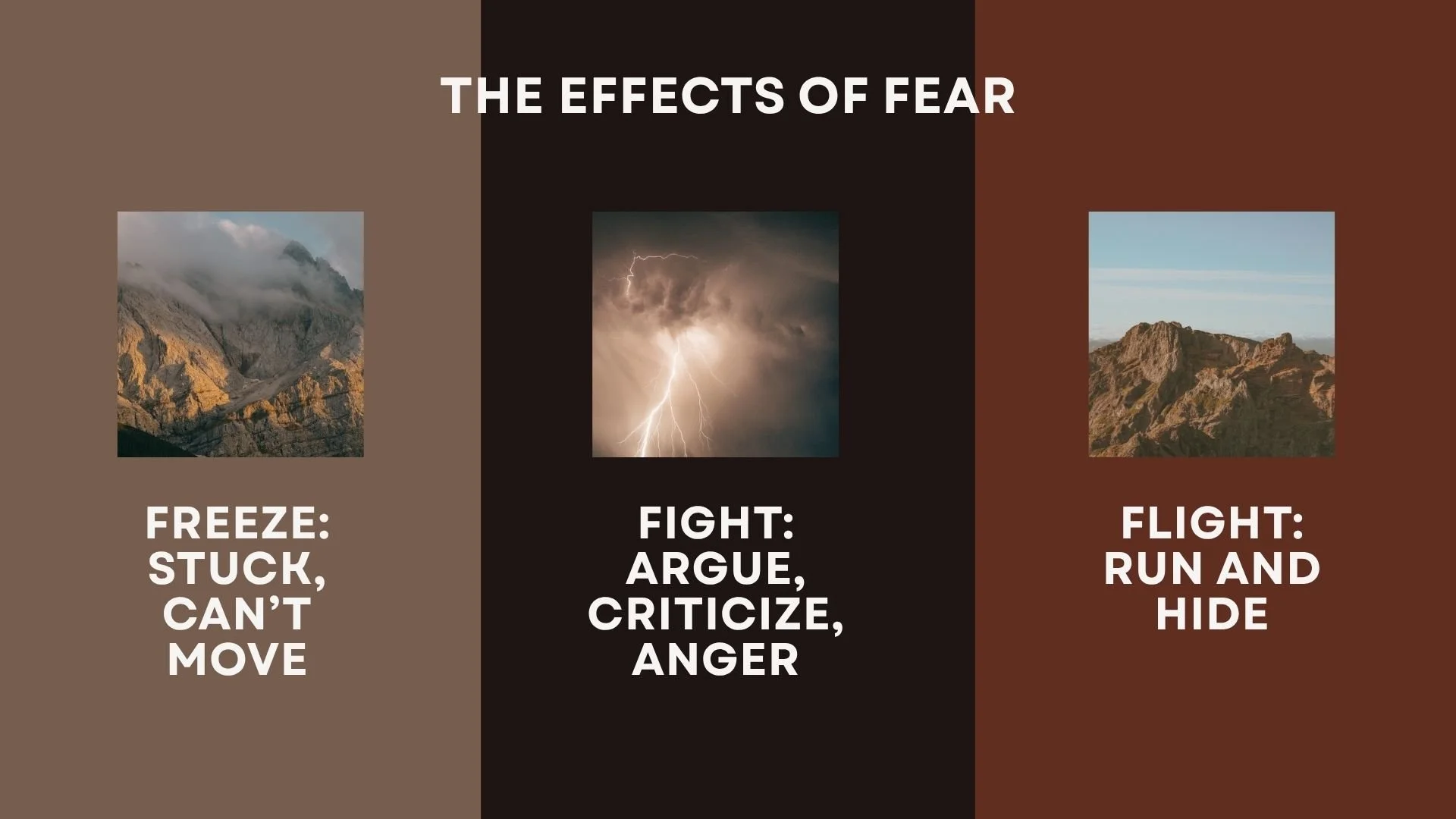
Sermon slide, October 11, 2026.
But David shows us how to live free from the fear, even if our circumstances aren’t good. Despite being on the run and truly struggling for survival, he clings to the truth of his rock and anchor in the storm—he cries out to God for mercy and pours out his complaints; he repeats the truth that God watches over him and has never and will never leave him. He is in desperate need, but he trusts in God’s protection and provision. In Psalm 141, David says, “My eyes are fixed on you, Sovereign Lord; in you I take refuge.”[7]
As I pondered this relationship between faith and fear, I recalled that recent research has shown that those who have faith are more resilient in difficult times. Studies have been done on war veterans, the aging population, prison inmates, and cancer patients, just to name a few. In each case, it has been found that faith and spirituality—including regular spiritual practices like prayer and Scripture reading, communal worship, and reliance on relationships within this community—results in better coping with the unexpected things in life, reducing anxiety and depression, and increasing one’s quality of life.[8] And, as tomorrow is Thanksgiving, it’s also worth noting that a regular practice of gratitude reduces anxiety, fear, and depression.[9]
In other words, we have a choice as to what we will fix our eyes on. Saul sat with his spear on his hill—he is the picture of power and authority but absolutely crippled by fear. David hides in the hills—he is powerless and vulnerable, but he finds peace by fixing his eyes on God and allowing others who searched for refuge to come to him.
You might notice that God is not explicitly active or moving in this chapter. Where is he? Well, we can see the fruit of his presence with David, and the absence of his presence with Saul. To those who consistently turn their eyes on him, God is present and provides just what we need. To those who insist on living life reactively to what fear dictates, God is absent.
St. Ignatius calls these movements toward or away from God consolations and desolations. Ignatius encourages us to take time daily to examine ourselves and see where we have moved toward God and his love and experienced his presence in our lives even in the struggle, and also where we have moved away from God deeper into our pride, self-sufficiency, and fear and experienced the absence of God in life.
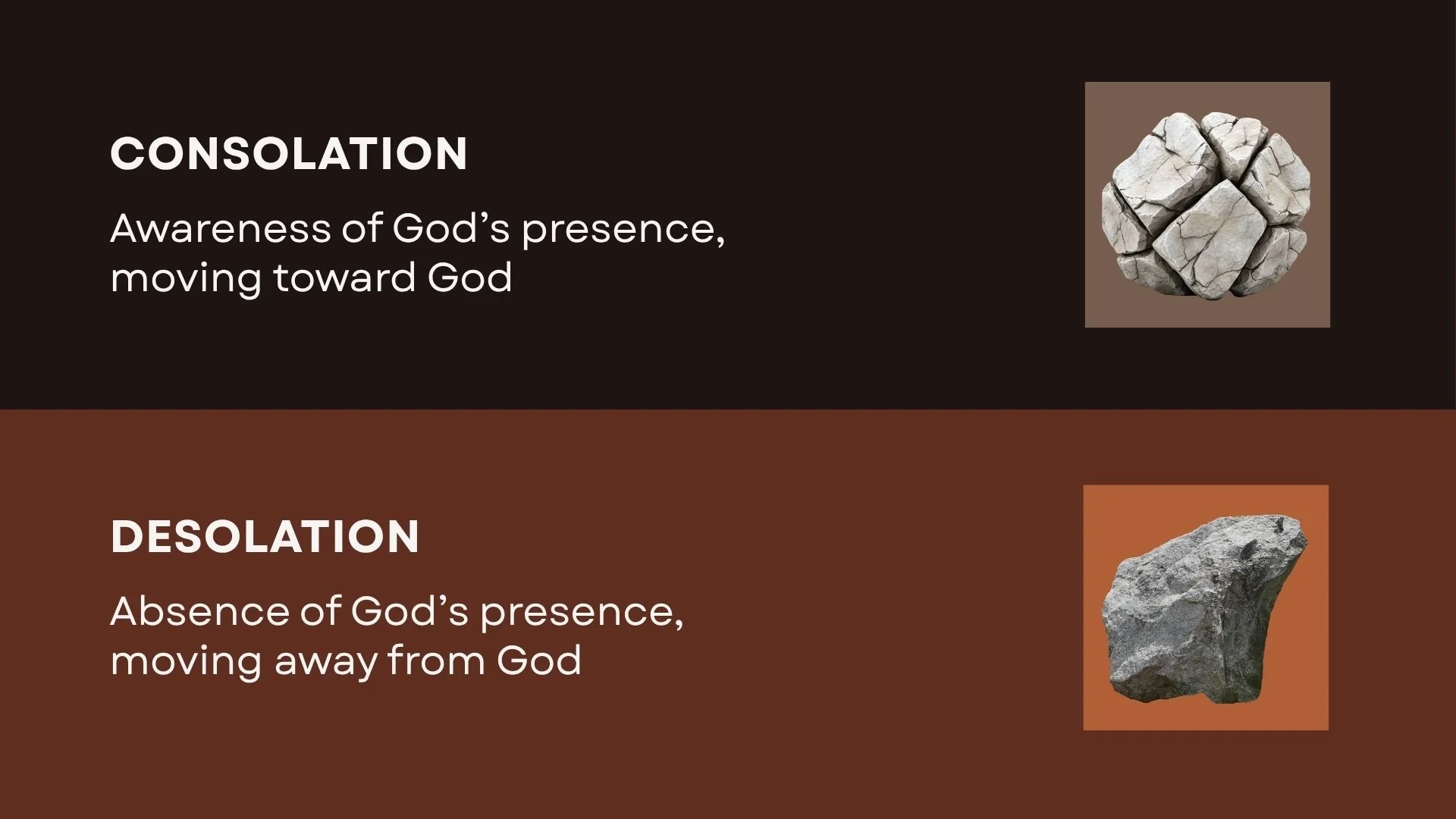
Sermon slide, October 11, 2026.
This week, try noticing where God has shown up in your life. Where have you felt his presence? Where have you moved toward him? Where have you moved away from him, and how is he inviting you to leave your fear behind and walk closer with him?
And how can we move toward God, as David did? How can we fix our eyes on him? One very simple way to start is with a daily prayer of gratitude. Thank God for one thing that you’re thankful for today. And then, tomorrow, do it again. And the next day, do it again. And slowly, you will become a person that is transformed from fear to peace, someone who has found refuge in God’s faithfulness and extends refuge to others. It doesn’t happen quickly or easily, but through the steady fixing of our eyes on the goodness of God.
Footnotes
[1] 1 Sam 8:17–20, NLT
[2] Ps 142:1–7, NLT
[3] 1 Sam 22:7–8, NLT
[4] 1 Sam 22:13, NLT
[5] 1 Sam 22:23, NIV
[6] Arnold, 1 & 2 Samuel, 315–6.
[7] Ps 141:8
[8] Dolcos F., Hohl, Hu, & Dolcos, S. “Religiosity and Resilience: Cognitive Reappraisal and Coping Self-Efficacy Mediate the Link between Religious Coping and Well-Being,” J Relig Health, 60(4) (2021), 2892–2905, doi: 10.1007/s10943-020-01160-y. See also Campell & Bauer, “Christian Faith and Resilience: Implications for Social Work Practice, Social Work & Christianity, 48(1) (2021), 28–51, doi: 10.3403/SWC.V48I1.212; Manning L., Ferris M., Rosario C.N., Prues M., Bouchard L. “Spiritual resilience: Understanding the protection and promotion of well-being in the later life.” J Relig Spiritual Aging, 31(2) (2019), 168-186. doi:10.1080/15528030.2018.1532859.